
Setting the Virtual Scene
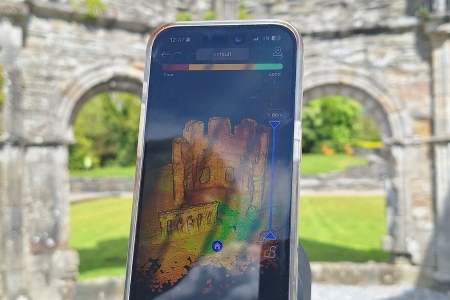
On a sunny day in May we travelled with our partners from the HEAT consortium to Mellifont Abbey to capture the beautiful12th century octagonal lavabo structure using volumetric capture technology. This moving location, steeped in history, will be used to create the virtual staging for the XR Opera pilot as part of the HEAT project in 2027.

The capture session was led by Aljosa Smolic, Co-Head of the Immersive Realities Research Lab at the Lucerne University of Applied Sciences and Arts. The purpose was to test state of the art technology, like the Portal Cam X Grid, against more widely available capture methods, such as those available on a smart phone, to create gaussian splats of the location. The outputs created will feed research into capture methodologies for creating immersive sceneographies using a variety of devices.

Irish National Opera is keen to explore the storytelling methods of the future and is using the HEAT project to test new design processes and rehearsal and performance workflows for hybrid mixed reality presentations of opera. Director Jo Mangan was on hand to imagine the audience experience and advise on how that might impact on the capture and design of the virtual scene. These methodologies open up a whole new avenue for exploring our built heritage in a performance context, providing audience access to locations that would otherwise be wholly unsuitable for an operatic performance and offering audiences the opportunity to experience live opera in virtual representations of some of our most iconic locations.

The next stage of our process will utilise the outputs from this capture to create a virtual scene for the hybrid XR opera staging of an aria from Donizetti’s Lucia di Lamermoor. We will work with VR experts at French company Immersion to create the scene and design the virtual audience experience.
Many thanks to the Office of Public Works for facilitating our capture of this beautiful monument, and to our HEAT partners at HSLU and DCU for assisting with our tech requirements.

If you want to read more about our previous experiments as part of the HEAT project, you can do so here.