
Putting Carmen on the operatic map - In Conversation with Michael Dervan
It’s a classic story of creative misfortune.
Georges Bizet died of what would later be identified as “a cardiac complication of acute articular rheumatism” at the age of 36, too soon to see the success of Carmen, his life’s greatest and most enduring achievement. After its Paris premiere on 3 March 1875 the work had been censured both for its morals and its musical style. Bizet is said to have complained on the opening night, “Don’t you see that all these bourgeois have not understood a wretched word of the work I have written for them?”
dialogue (part and parcel of the ethos of the Opéra– Comique) replaced by Ernest Guiraud’s newly-composed recitatives. Guiraud would go on to provide the same service for Offenbach’s Les Contes d’Hoffmann.
By the time Carmen returned in glory to Paris in 1883, it had been widely produced in cities including Brussels, Antwerp, St Petersburg, Stockholm, London, Dublin, Cork, New York, Philadelphia, Melbourne, Naples, Hamburg, Berlin, Prague, Geneva, Zurich, Mexico, Rio de Janeiro, Malta, Barcelona and Buenos Aires.
And it had also made its way through more than thirty French theatres outside Paris.
Success, of course, is relative. When Bizet died on 3 June 1875 Carmen had already had over 30 performances on the stage of the Opéra- Comique. Given that Bizet experienced the work as a failure, that’s a tally most composers of our own time must surely look at with amazement.
The work’s fortunes changed quickly, but not on the basis of the Paris production. It was on 23 October 1875 that Viennese audiences heard Carmen for the first time, sung in a German translation, and with the original spoken The Irish premiere, given in Italian at Dublin’s Theatre Royal on 9 September 1878, was a production by the great English opera impresario James Henry Mapleson (1830– 1901), whose memoirs covering the years 1848 to 1888 provide a colourful account of the ups and downs of touring opera in the 19th century. Mapleson was successful enough to have operated on both sides of the Atlantic, 24 New York Herald, 21 February 1891 and his performances in Dublin and Cork were a late addition between those planned for London and New York. The work was being presented for the first time in all four cities.
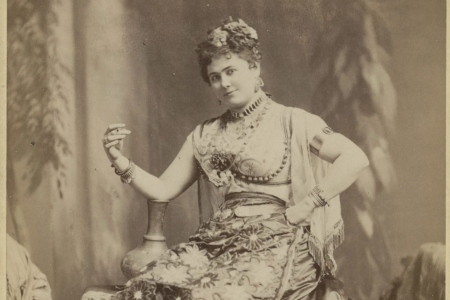
The *Carmen *was the American singer Minnie Hauk (1851–1929), the first American singer to conquer Europe. In a career path unimaginable today, she made her debut as Amina in Bellini’s La sonnambula just a month shy of her 15th birthday, sang Juliet in the US premiere of Gounod’s Roméo et Juliette a year later, and made her European debut – for Mapleson – at Covent Garden, in October 1869. Carmen was her most famous role. She sang it more than 500 times, and in four languages. She gave her last performance in the mid 1890s and her career, though short, was glorious.
She was so well known that she featured in an advertisement in which the sales line under her photograph simply stated: MINNIE HAUK USES WARNER BROs CORALINE CORSETS – coraline, Minne Hauk as Carmen 25which was plant-derived, was marketed as a more durable and pliable alternative to whalebone. Her high-handedness and her disagreements and disputes with colleagues functioned as fuel for a well-oiled publicity machine. Her reputation seems to have been based as much on her acting as her singing, and her assumption of Carmen has been credited by the opera scholar Clair Rowden with having “sealed the opera’s ‘bankability’ for all time”.
The Italian composer and conductor Luigi Arditi – whose vocal waltz Il bacio is still performed today – conducted her Irish performances of Carmen. He had first heard her when she was 18.
“Her voice was a very high soprano,” he reported, “neither very powerful nor very rich, but clear and light, with a mezza voce of peculiar charm. There was no trace of vibrato to be detected in her notes (a very prevalent and rising evil among the singers at that time), and altogether Mdlle. Hauk, who was an American by birth, and a pupil of Maurice Strakosch, was at once declared to be a most finished singer and competent actress.” After she became a mezzo-soprano her voice was praised for force and richness.
In an 1878 magazine interview, Mapleson described the difficulty he had putting the cast together for the London performances.
“Campanini [Italo Campanini, the Don José] came to me and asked if the role of the walking gentleman was intended for him. Valeria [Alwina Valleria], who played Micaëla, thought it was the seconda donna’s part, and that it had been sent to her by mistake; while Del Puente [Giuseppe Dal Puente, the Escamillo], thinking it was a joke, came in smiling, with what he imagined was a chorister’s part. Every man Jack of them had some excuse for staying away at rehearsal, and it was by dint almost of sheer force that I pushed the opera to the lights.” Hauk was not a problem in this regard. Mapleson’s interest in presenting the opera in the first place had been sparked by seeing her in the role in Brussels.
The production was designed by Bruce Smith (1855–1942), a scenographer whose eye for realism and interest in special effects would earn him the nickname Sensation Smith. Realism was the hallmark of Hauk’s approach, too. In London she had found fault with the approach of the conductor Michael Costa. She described him as “irritable and quick tempered...stubborn, tradition bound”. She preferred Arditi, and found him more broad-minded, more open to presenting “a performance in which acting and scenic effects would go hand in hand with singing”.
Hauk’s verdict on her colleagues initial responses to Carmen was harsh. “The real reason for their refusal,” she wrote later in her autobiography, “was that they had been singing mostly purely Italian music in front of the footlights, without making any effort to act the parts.” Most opera heard in London and Dublin in the second half of the 19th century New York Herald 22 February 1891 was sung in Italian whether it was composed in Italian or not. That fate befell not just Carmen, but even Stanford’s The Veiled Prophet, which was performed in London in 1893 as Il profeta velato, even though the original libretto was in English.
Hauk elaborated on the singers hesitancy about Carmen. She wrote, “To deviate from the traditional windmill acting, to the average Italian singer, would surely mean disaster. The movement of hands and arms by the Italian soloists and choristers when singing ensembles in their old Bellini or Donizetti operas was often a sight to behold. They looked as though they were being drilled for optic telegraphy or railroad switching. They stood, to all appearances, nailed to the boards, the soloists in a straight-line right in front, the choristers two or more lines behind, the men on one side, the women on the other, and every high note was accomplished by the raising of their right arms! This would never do for Carmen. In Bizet’s opera natural action, life, and varied movements meant as much as the singing, one blending into the other.”
So, if we are to take Hauk at her word then Carmen must be counted a kind of landmark for opera production in Dublin, too. It was anything but a definitive landmark. In the style of the time, Hauk was dressed with a richness no cigarette factory worker would ever be able to afford. The kind of realism that would take account of the sweaty conditions of a factory floor was still in the future.
Written by MICHAEL DERVAN