Giving Mary a Voice: Colm Tóibín and Tarik O’Regan on Testament
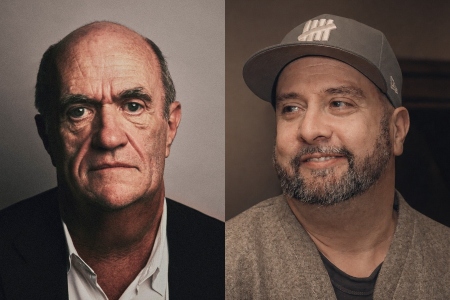
Ahead of the world premiere of Testament, Irish National Opera sat down with writer and librettist Colm Tóibín and composer Tarik O’Regan to talk about bringing The Testament of Mary to the operatic stage.
Adapted from Tóibín’s acclaimed novel, Testament gives voice to Mary in old age: a woman who has lived through trauma, grief and silence, and who now speaks for herself. In this conversation, Tóibín and O’Regan reflect on music, memory, truth, collaboration and why this ancient story feels urgently contemporary.
What made you want to return to The Testament of Mary as an opera?
Colm Tóibín:
Part of Testament began with song. It began with music, with me listening to Bach’s cantatas, Bach’s Passions and Bach’s Masses, especially the role of the contralto or the mezzo. That emotion which rises up out of worship, or out of the story of the New Testament, especially Saint John’s Gospel and Bach’s St John Passion, began there. I was trying to work out whether there was a way of rendering that emotion in words. So, in a way, the final destination being opera brings it right around: from an emotion that began with me listening to music, to ending with the words I wrote being put to music.
What first drew you to Colm’s novel?
Tarik O’Regan:
The thing that always drew me to the novel was not so much the biblical character of Mary, but the idea of someone who has not yet been allowed to speak. Who is allowed to speak? When is someone allowed to speak? When is what they say written down? What gives something its authority, and how is that related to authorship? The Gospel writers that we know won the battle of transcription. We know those stories. You might say that the person who lost was the person who didn’t write. So who was Mary? That relationship between the spoken or sung word and the written word really drew me to the text from the beginning.
How did your collaboration with Tarik develop?
Colm:
I told Tarik from the very beginning that I understood the role of the librettist to be at the service of the composer. I had already expressed myself because I had written and published a novel. My job now was to offer him a blueprint from which he could work. If he wanted more or less, if he wanted something and not something else, it was my job to provide that for him. So it was, in fact, a sort of service rather than a collaboration.
How did you and Colm shape the story for the stage?
Tarik:
Colm is a terrific collaborator. It is very interesting when you have a writer adapting their own work from another form, because that original form remains unchanged. We can all go to the novel, and it is still there. So from the beginning, he was creating something new from that raw material. It was not simply an editing job. He has written a new work, exciting in its own right. As a composer working with a librettist, you are always requesting changes because something may be difficult to set, or a word may not quite work. Colm has been very good at making those revisions quickly and talking through ideas. He has given the text enough breathing space so that the composer can do their job. He is also a terrific poet. In reinventing the novel, he has essentially created a long-form poem.
How would you describe The Testament of Mary in one sentence?
Colm:
Mary, the mother of Jesus, in old age speaks. She only speaks once.
What kind of sound world did you imagine for the opera?
Tarik:
From the very beginning, I knew it was going to be an intimate sound world, and an opera of equal parts. Not in the conventional sense of chorus, orchestra and soloists. These are all lines of equal importance. Whether you are playing Mary, singing alto in the chorus, or playing cello, you are a line in the weaving together of the fabric of this story. I didn’t want to pretend that the orchestra wasn’t there. I wanted everyone to have a relationship on stage. They are part of the community telling the story. That changes the sound world. The minute you have voices and instruments coming from the stage, and the performers are moving and acting, you get an audible shift of sound. This shifting, intimate sound world was there from the beginning.
What interested you about giving Mary a private, human voice?
Colm:
The idea occurred to me that if she spoke, what she would say would be very interesting. It was a question of finding a sound. Even though you read it in silence in my book, nonetheless it is a voice. It is written in the first person. It is her speaking. The idea was that she was old, she had nothing to lose, and she had a great deal to say. Her memories are different. Her testament is different to the official testament - as anyone who has ever witnessed anything and then reads the official report might say, no, it wasn’t like that.
How does the opera explore memory and truth?
Tarik:
The piece is very concerned with memory and the truth of memory. Whether a memory is factually true may or may not matter to the person having that memory. A memory can be factually inaccurate but deeply real for someone. Because of that, there is a fluidity to the way the music moves. Material comes in and out in different guises. It asks everyone in the room - audience members and performers - to think about what truth means, how we express it, and who we allow to speak.
Why was it important to place Mary’s grief and anger at the centre of the story?
Colm:
Mary is traumatised. She has never spoken about it. She has held it all within. So, obviously, when she speaks, there has to be something explosive - something absolutely real and explosive in her sound.
What has it been like hearing Sharon Carty as Mary?
Tarik:
Sharon Carty is absolutely fantastic. She has the ability to command attention through quietness, and that is very important in this opera. Mary is old, at the end of her life, reliving a deeply traumatic event. There is inner pain and inner anger, but this is not someone with the physical power to shout. A lot of it is quiet intensity. Sharon has the big operatic voice, but she also has that powerful, quiet, intense low range that mezzos can have. She is able to move between the multiple sides of Mary seamlessly. This is not a passion play. It is not simply a retelling of biblical stories. If anything, it is a psychodrama. We are in and out of Mary’s head. Sharon has really understood that from the beginning.
Can opera deal with this story differently from a novel or a theatre piece?
Colm:
Opera is a great collaborative art form. It works with words, music, design, light, movement and singing. It has a sort of soaring power. If you tried to get that in a novel, it would be pure chaos and sentimentality.
Is the chorus used in a traditional way?
Tarik:
There are 16 singers in the chorus, but they are not a conventional chorus. They do not come on, do the chorus thing, and then leave. The chorus is not really a chorus — it is a collection of voices. Sometimes they are used in their full force. Sometimes it is just one voice at a time, or different combinations of voices. For me, it is part of the fabric of the piece: 16 singers, seven instrumentalists and Sharon. It is a tapestry made of individual threads.
What might surprise audiences who think they already know Mary’s story?
Colm:
People know Mary’s story from prayers and from the Gospels - Matthew, Mark, Luke and John. But it is mainly a story in which she is silent. This is the time she speaks.
What do you hope audiences take away from the opera?
Tarik:
For me, it is about the piece coming to life in 2026. Yes, we can discuss life 2,000 years ago. We can discuss gender equity and inequity, oral tradition versus written tradition, authorship, authority, faith and crises of faith. All of those are valid things to take from it. But for me, this is also about a world where artificial intelligence is moving so quickly that our understanding of truth is becoming blurred. This is an opera called Testament, about testimony. Traditionally, testimony is sworn under oath. There is an idea that you are telling the truth. For the first time in my life, I cannot look at a photograph, a video or a piece of writing and know whether it is the truth or not. At the heart of the opera is the question: who determines what truth is? When you hear it, do you know it? Who is allowed to write it down? Just because something gets written down first, does that make it more true? I think that is a question everyone should be asking themselves.
What do you hope audiences understand about Mary by the end?
Colm:
I want to reach beyond understanding into a state of emotion. It is about feeling. It is about connecting with another person, particularly with the singer. Understanding would be a debate, perhaps a debate for theologians. What I am attempting to create is a sort of soaring moment in the theatre - to reach just beyond understanding into a much purer and perhaps more complex place.
Why should someone come and see this opera?
Tarik:
You should come and see this opera because it is a fully immersive, hybrid experience. You are going to see something that is not what you might usually associate with opera: orchestra in the pit, chorus on stage. This is everyone doing everything. It asks a very important question: why do groups of people come together to tell a story? Irish National Opera has brought together an incredible group of people to tell this story. We think it is urgent and important. I hope audiences will walk away thinking about it for a long time afterwards. Above all, I want it to be, in the broadest sense, an entertaining and compelling evening.